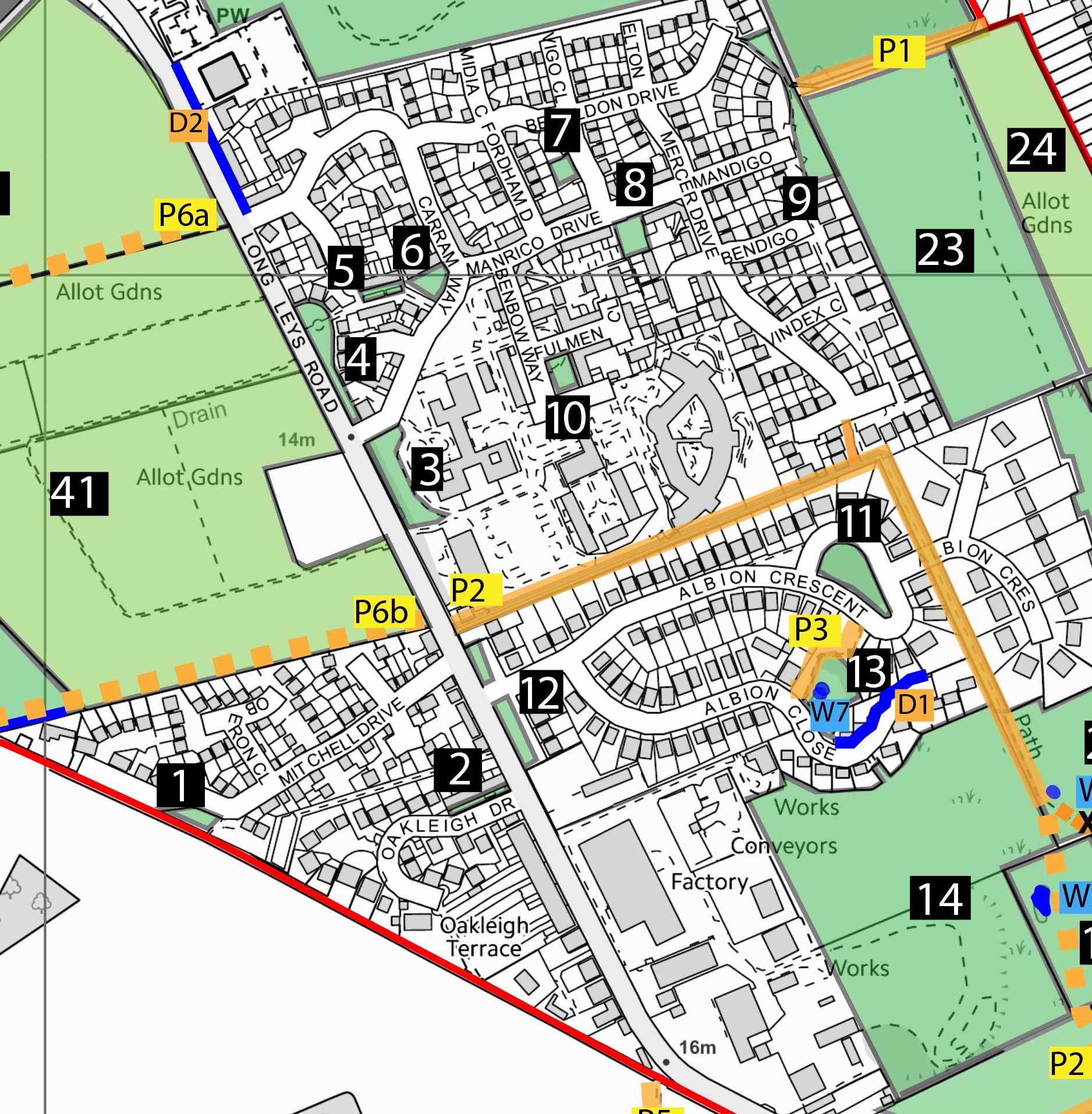
Development in Long Leys will be supported where it protects and enhances green spaces, biodiversity and natural features, in accordance with the following criteria:
1. Local Green Spaces – Development within designated Local Green Spaces (LGS) will only be supported in very special circumstances, such as for essential ancillary facilities that enable their use and enjoyment, and where the openness and community value of the LGS is not harmed. The LGS are
defined on Map 7 below , marked as spaces 1-14 and also defined in more detail in Appendix 1.
2. West Common and Burton Ridge -
Development proposals adjoining West Common or Burton Ridge woodland must demonstrate that they:
a) safeguard biodiversity, drainage, lighting and noise to avoid harm to these sensitive areas;
b) provide an appropriate landscaped buffer or transition zone; and
c) preserve or enhance public access to West Common, in consultation with the Commons Advisory Panel.
3. Trees, hedgerows and landscaping -
a) Mature trees and important hedgerows must be retained wherever possible.
b) Where loss is unavoidable and justified, at least a 2:1 replacement with native species is required, on-site or nearby.
c) New development includes a landscaping scheme with native trees and shrubs, and integrates features such as street trees, green roofs or living walls where appropriate.
d) Developers must protect retained trees during construction in accordance with BS5837.
4. Biodiversity and wildlife corridors -
a) All proposals deliver at least 10% biodiversity net gain, measured using the statutory metric.
b) Ecological connectivity is maintained and strengthened, including hedgerows, ditches, gardens, and wildlife crossings.
c) Schemes should include features such as habitats (swales, ponds, rain gardens), pollinator-friendly planting, and nesting/roosting features (e.g. swift bricks, bat or owl boxes).
5. Green buffers and views -
a) Where development lies at the neighbourhood edge, a landscaped buffer with native planting is provided to soften the transition to open countryside.
b) Proposals take account of valued views (such as across fields from the A46), incorporating design solutions to retain openness and visual connectivity wherever practicable.
6. Protected species and ecology surveys
Development on greenfield or habitat-rich sites must be informed by an ecological survey. Where protected species are present, proposals must include mitigation and/or compensation measures in line with legislation and best practice, to ensure continued ecological functionality.